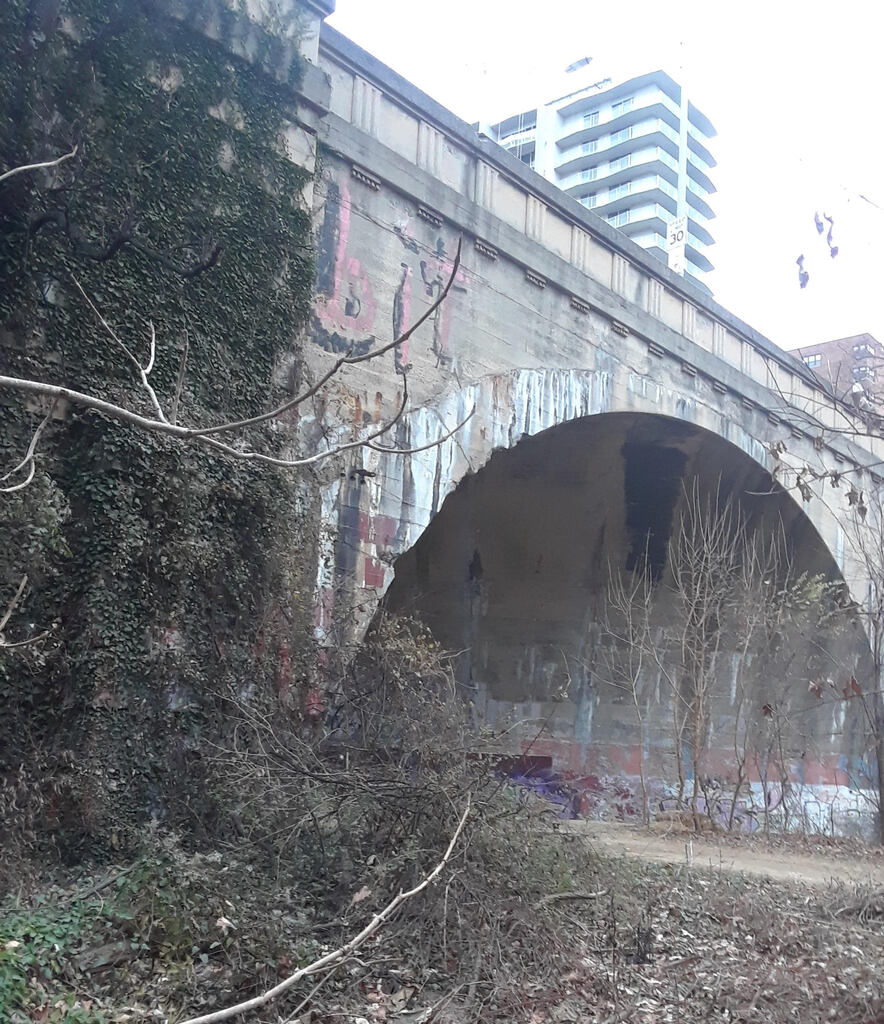
University Parkway Viaduct
Text
The West University Parkway concrete bridge arcs over Stony Run to connect the neighborhoods of Roland Park and Tuscany-Canterbury. Hikers can follow a pedestrian pathway from Wyman Park, and walk under the bridge, which serves as a viaduct since it carries University Parkway in an arc over Stony Run, before entering the Tuscany-Canterbury neighborhood. This bridge not only connects these neighborhoods but those living in nearby residential apartments, whether the Carlyle to the Northwest, the historic Tudor Arms Apartments to the Southwest, and various apartment complexes to the Southeast, such as Hopkins House, the Carolina, and University West apartments. The viaduct also ensures easy access to John Hopkins University’s Homewood campus which sits less than a half of a mile southeast of the bridge. Etchings on the bridge's four corners indicate that it was constructed in 1908. Although a map released in 1906 seems to show that the bridge was present, this is referring to a previous steel trestle bridge, which the Olmsted Brothers saw when surveying the land a year before. The new bridge was wide enough to accommodate vehicles, trolleys, and pedestrians at the same time. One early design for the bridge was proposed by city engineer Benjamin T. Fendell. He was influenced by the ideas from the Olmsted Brothers, who recommended improvements to enhance the bridge's "architectural beauty," so that the design did not appear "weak." Ultimately, Wyatt & Nolting Architects, a partnership between architects William G. Nolting and James B.N. Wyatt, known for the Clarence M. Mitchell, Jr. Courthouse, and later for the Physics Building on the Homewood campus and the Garrett Building in downtown Baltimore, were chosen to complete the final design. The bridge itself was constructed by the city’s engineering department for a cost of $25,000. At the time of its construction, the Maryland and Pennsylvania (Ma & Pa) railroad had been running alongside Stony Run for four years, through the newly-created Wyman Park. The Olmsted Brothers described the latter, in their comprehensive 1904 report on development of public grounds in greater Baltimore, as a "beautiful piece of sylvan Scenery" and noted its beach trees and topography. The trustees of Johns Hopkins University, including William Wyman (which Wyman Park is named after), had deeded these lands to the city. The Ma & Pa railroad would continue to run under the viaduct until June 1958. University Parkway, which replaced Merryman Lane, a narrow country road, allowed for the construction of many buildings in the area. This included Tudor Hall in 1911, which opened for residents in 1912. It would later become the North Building of a housing cooperative named Tudor Arms. A few years after the bridge's construction, the Homewood campus of Johns Hopkins University came into existence. There were plans to incorporate the campus into the city grid. Although the campus opened for students in 1914, the full relocation of the university to that location would not be finished until two years later. Spanning almost 87 feet, this concrete arch viaduct is considered one of the most notable, and historic, bridges in the U.S., possibly for its wide span, its design, the fact it has remained intact for over 117 years, or because it connects two neighborhoods together. The bridge, according to a report prepared for the State Highway Administration in October 1995, showed the city's commitment to arch design. This is because the same year the city began construction of two other reinforced concrete bridges, one at Hollins Street, over Gwynns Run, and another at Edmondson Avenue, over Gwynns Falls. The viaduct encouraged additional residential development. The Topographical Survey Commission of Baltimore noted, in a 1912 report to city leaders, that the land required for building University Parkway was deeded without cost to the city by Johns Hopkins University and the Roland Park Company, and praised this land grant to the city for its advantages. The viaduct also helped connect the city's parks. A few years later, the city installed street lamps along the bridge. Some years after that, in 1919, curbs and sidewalks along the bridge were raised and improved. The University Parkway viaduct remains intact to this day, continuing to serve as a vital route used by residents, delivery services, emergency vehicles, and others alike.
Files
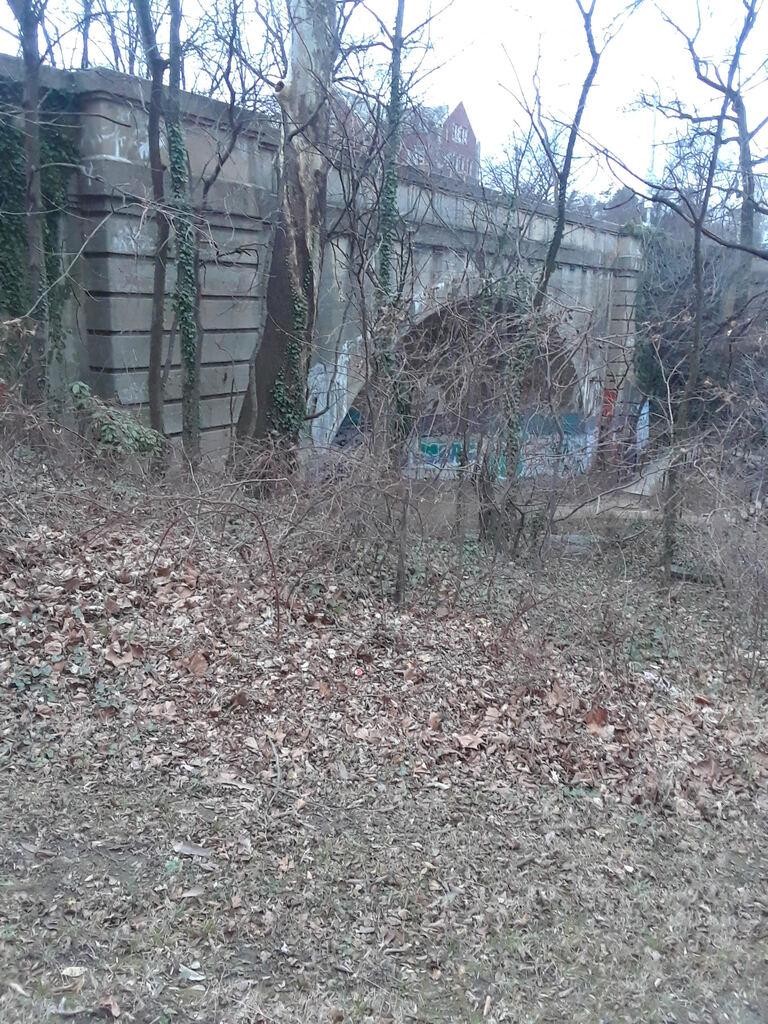
University Parkway Viaduct
Photograph of the concrete bridge from the Southeast side, showing it arcing over Stony Run, with the view of the bridge somewhat obscured by nearby trees. The historic Tudor Arms Apartments is shown in the background | Source: Burkely Hermann | Date: December 8, 2025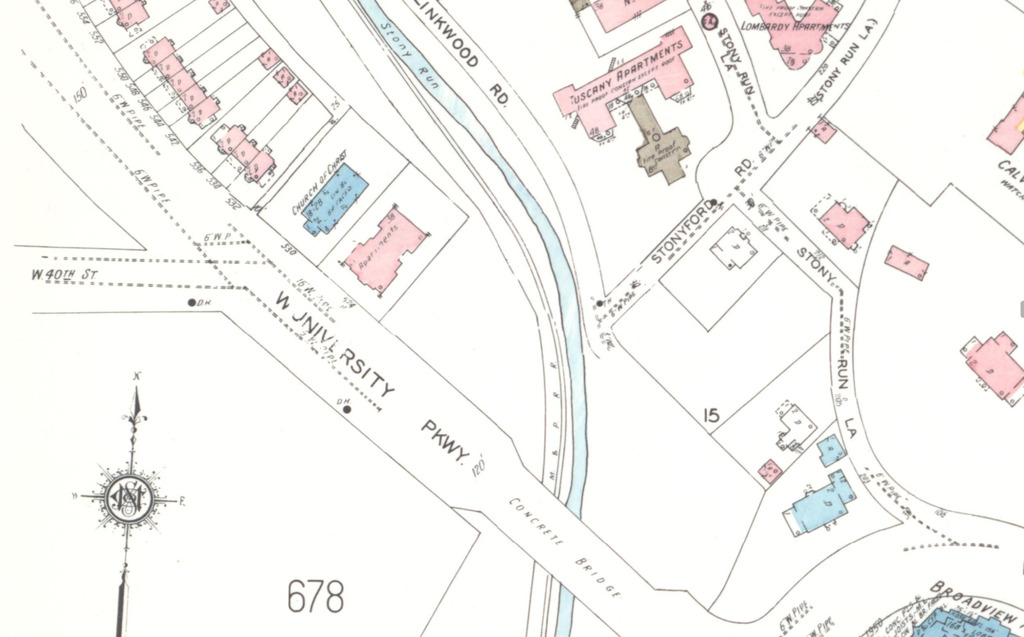
Map of viaduct
A map showing the concrete bridge of West University Parkway over Stony Run and noting locations such as the Tuscany, Lombardy, and Broadview Apartments, and the Church of Christ (established 1947) | Source: Library of Congress | Date: 1928 (republished 1953)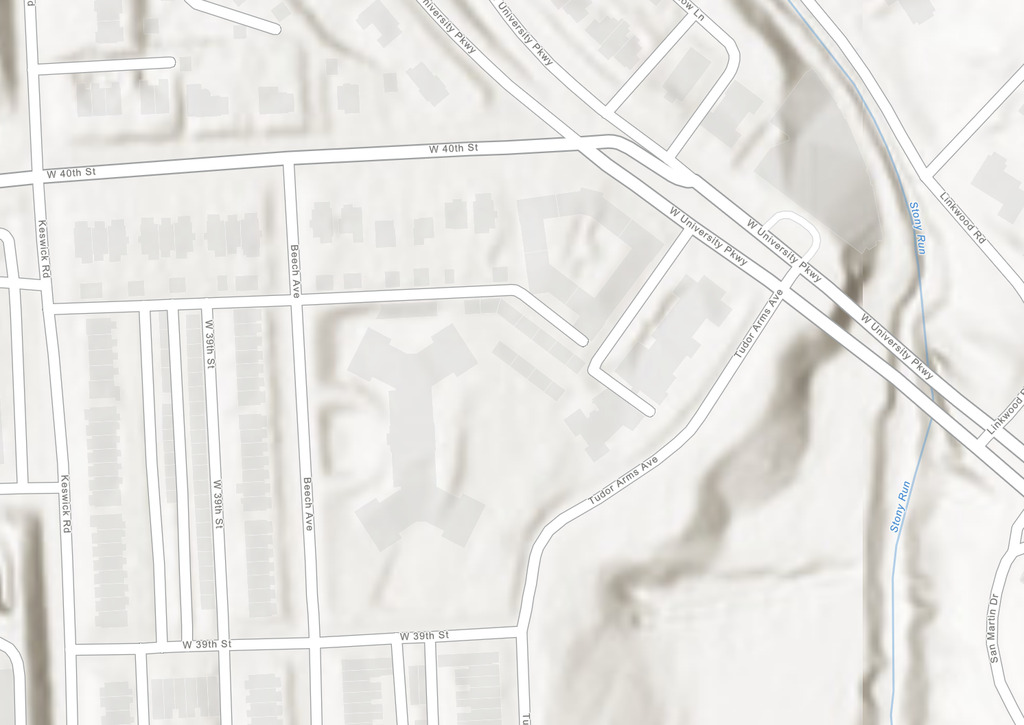
Topographical map
A topographical map with a close-up on the bridge over Stony Run, showing two lanes of traffic, nearby roads, and the valley in which the Ma & Pa railroad once used, alongside the stream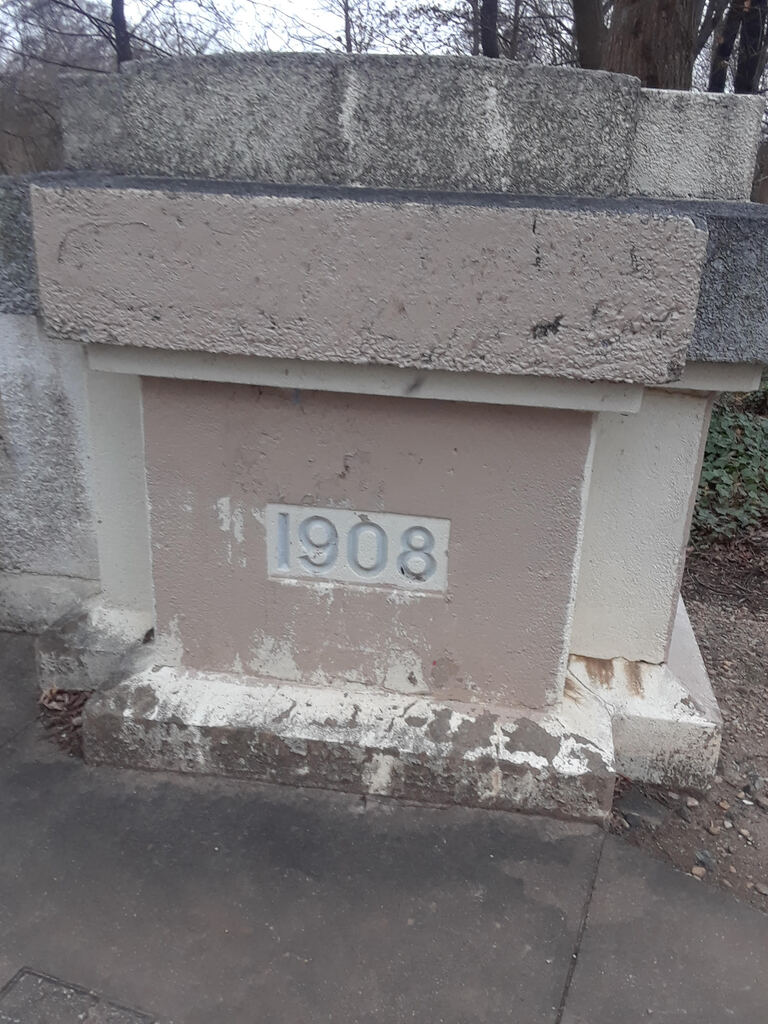
Close-up of bridge etchings
One of the four concrete etchings on the bridge, this one close to Tudor Arms Apartments, indicating it was built in 1908 | Source: Burkely Hermann | Date: December 8, 2025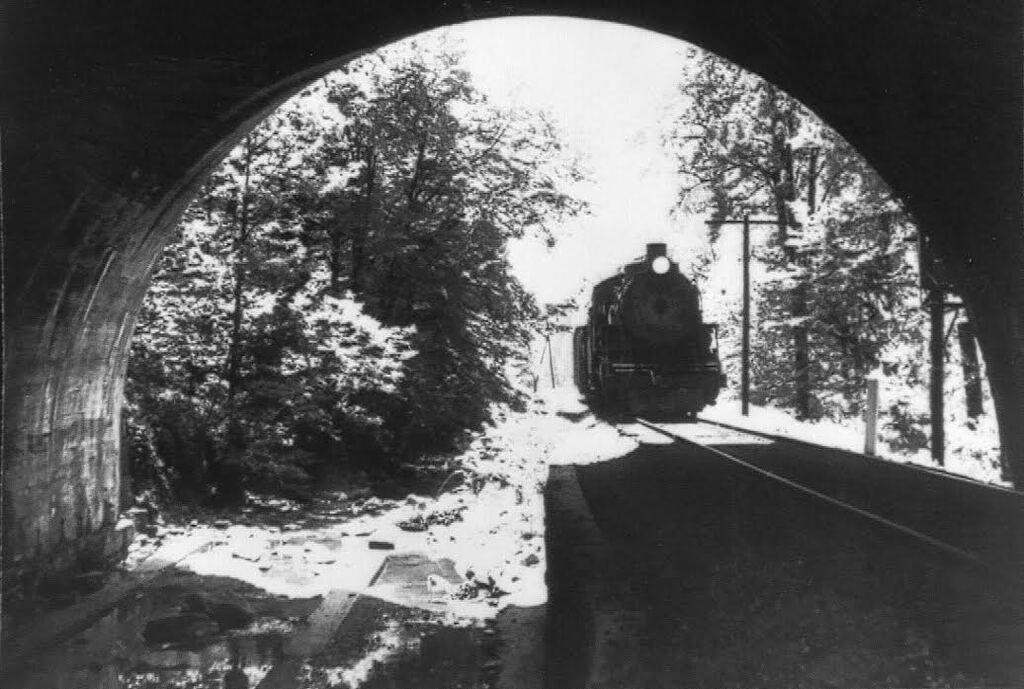
Locomotive traveling under the viaduct
Locomotive traveling under the University Parkway viaduct in 1951 | Source: Baltimore County Public Library / University of Baltimore Special Collections & Archives | Date: 1951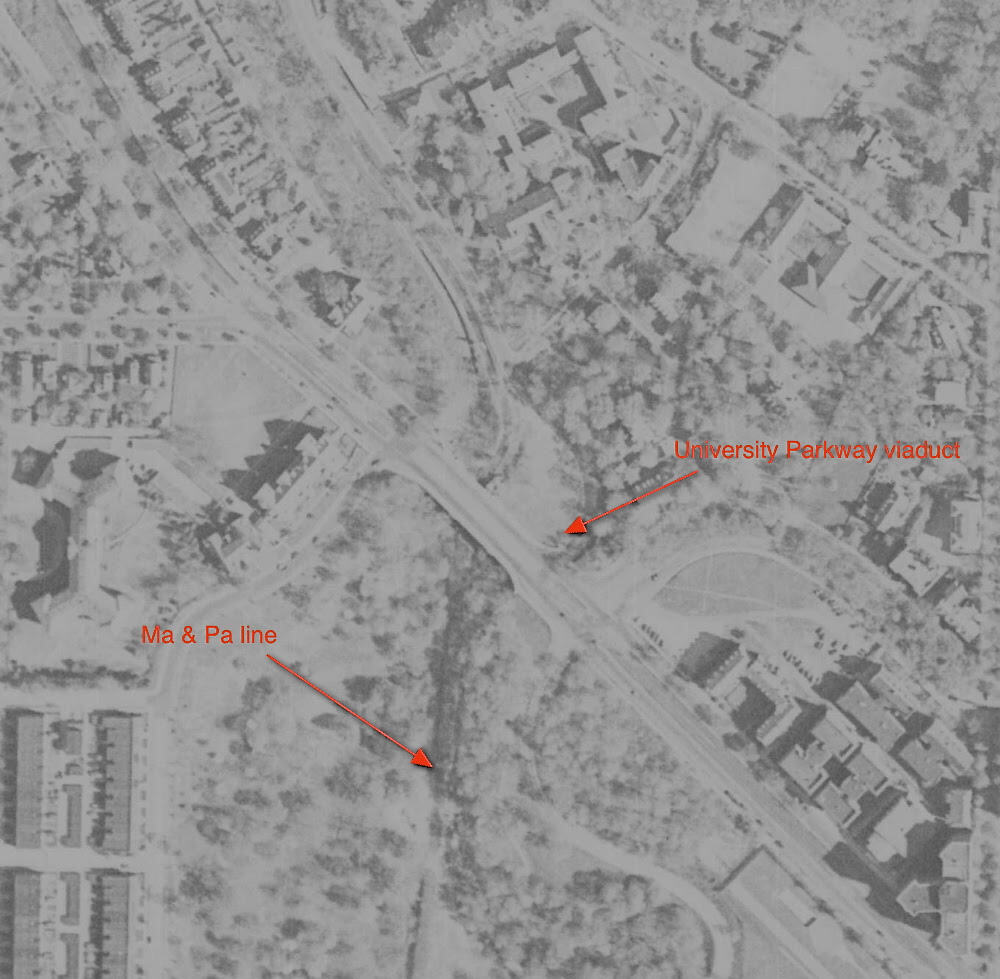
Aerial view
Aerial view showing the area around the University Parkway viaduct with arrows and red-typed letters indicating the location of the viaduct and the Ma & Pa railroad line along the valley in which Stony Run flows | Source: U.S. Agricultural Stabilization and Conservation Service (ASCS). 1938. "1937-1938 Baltimore City & Baltimore County: Aerial Photography Flown in November and December of 1937 and in April and May of 1938." Washington, D.C.: ASCS. / University of Baltimore Special Collections & Archives | Date: 1938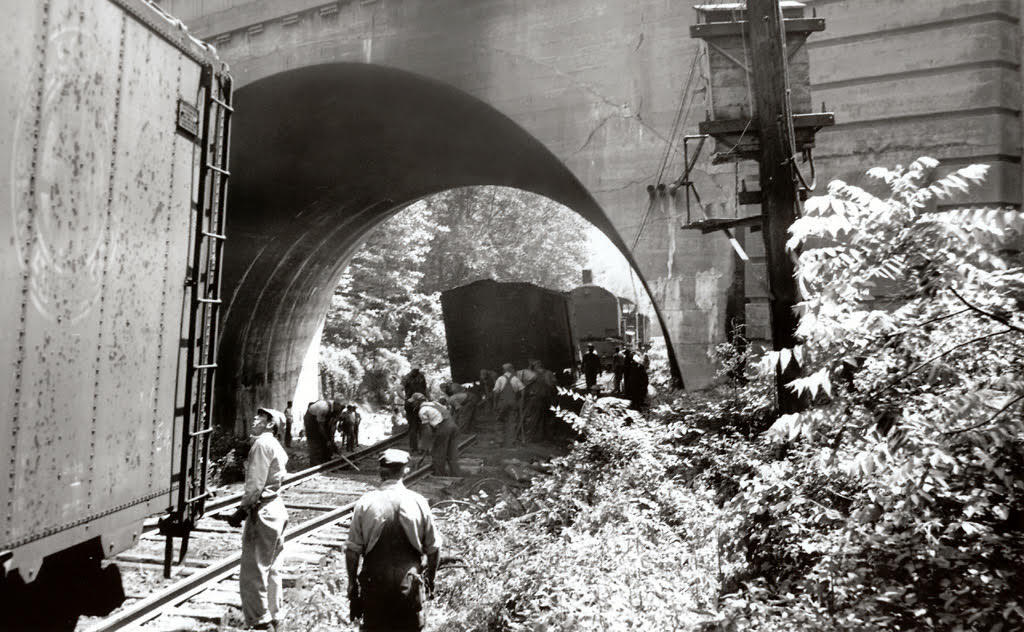
Train derailment
Black-and-white photograph of train derailment near University Parkway viaduct in 1940s, showing workers and the nearby plants present at the time | Source: MDRails.com / University of Baltimore Special Collections & Archives | Date: c. 1940s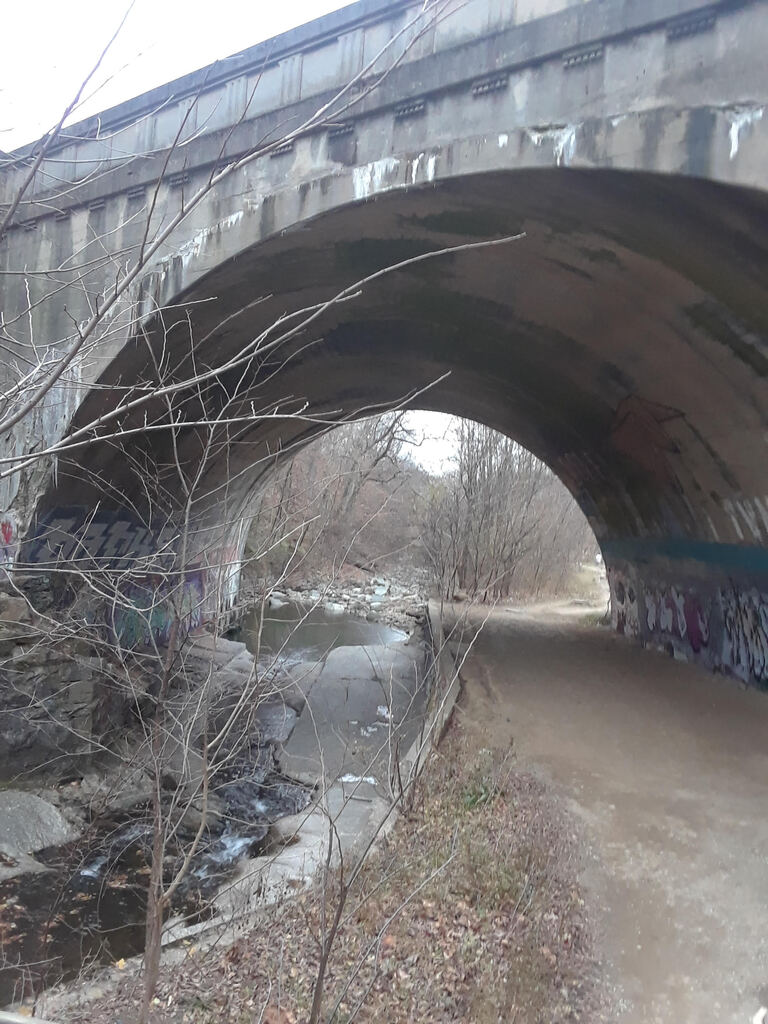
Present-day look underneath the University Parkway viaduct
Present-day look underneath the University Parkway viaduct, showing the wear-and-tear on the concrete structure, with a walking trail in the area where the railroad tracks once ran, and the Stony Run down below | Source: Burkely Hermann | Date: December 8, 2025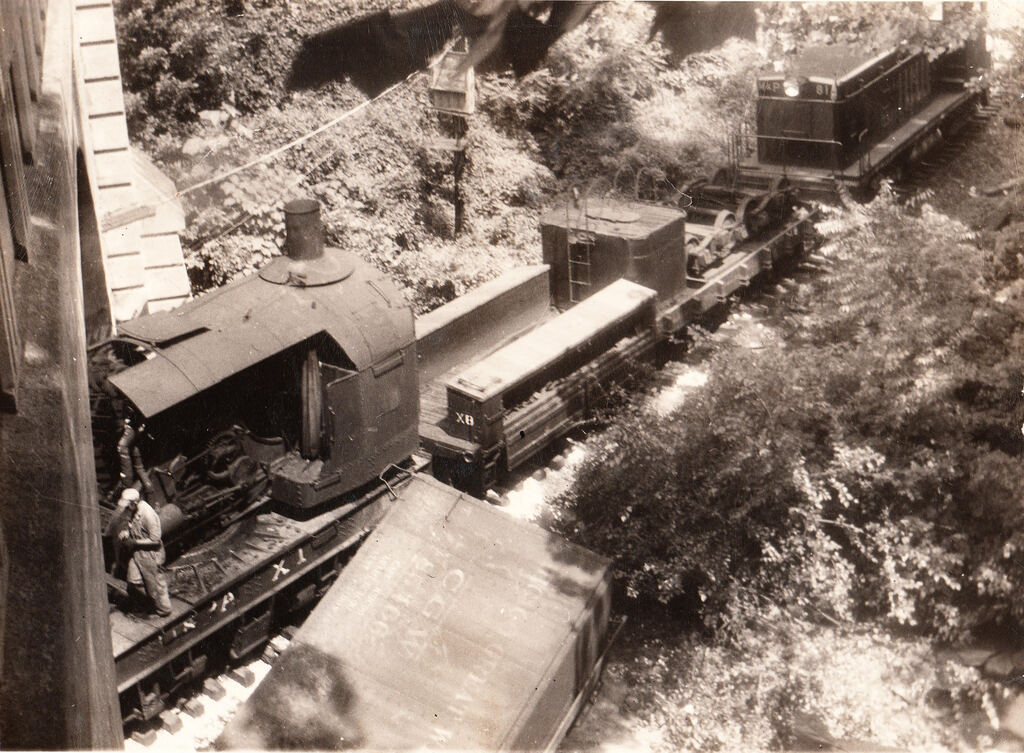
Sepia-tone photograph of peering over north side of University Parkway viaduct in 1940s
Sepia-tone photograph of peering over north side of University Parkway viaduct in 1940s, showing workers, train cars, the locomotive, and scrubby plants around the train tracks | Source: John H. Pleier collection / University of Baltimore Special Collections & Archives | Date: c. 1946-1948